Watch video – Saeed Hassanpour, a professor of biomedical data science, is featured in a segment about a first-of-its-kind symposium held this week at Dartmouth that explored the potential benefits and pitfalls of artificial intelligence in healthcare. “It’s actually going to improve efficiency, going to reduce health care costs. It is going to improve the accuracy,” Hassanpour said.
Post Tagged with: "AI"
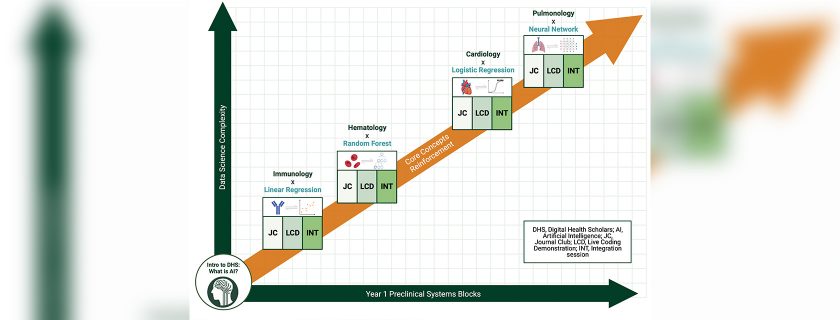
Geisel School of Medicine Students Introduce Artificial Intelligence to Preclinical Education
In the recent paper in the journal Medical Education Online, Geisel medical students detail the outcomes of a pilot study they designed and launched introducing AI concepts within the preclinical curriculum.
Microsoft’s Stake in Buzzy AI Lab Mistral Is Raising Eyebrows in the EU – Fast Company
Read article – Nicholas Jacobson, an assistant professor of biomedical data science and psychiatry, is quoted in a newsletter about the latest news in AI. Dartmouth researchers created an app, MoodCapture, that can identify cues associated with depression. “We think that MoodCapture opens the door to assessment tools that would help detect depression in the moments before it gets worse,” Jacobson said.
The MoodCapture App May See That You’re Depressed Before You Do – The Daily Beast
Read article – Features Andrew Campbell, a professor of computer science, in an article about his co-authored study wherein he, alongside Arvind Pilla, Guarini; Subigya Nepal, Guarini; and Nicholas Jacobson, an assistant professor of biomedical data science and psychiatry, developed an app powered by AI to detect signs of depression using cell phone facial recognition software. “The model focuses on a myriad of facial features, including expressions stemming from muscle activations, eye gaze, head pose, and the 2D/3D locations of various face landmarks such as lips and eyes,” Campbell said. “AI is used to derive meaningful insights from each image, including factors like lighting conditions, the number of people in the image, dominant colors, photo location, and background objects.” (Picked up by Yahoo! News.)
AI Enables Phones to Detect Depression From Facial Cues, Study Shows – UPI
Read article – Subigya Nepal, Guarini, and Andrew Campbell, a professor of computer science, are featured in an article about their study in which they developed an app that uses AI that detects depression from facial cues before the user even knows something is wrong. “We undertook this study to address critical gaps in traditional methods of monitoring and detecting depression. Traditional approaches often involve self-reports and clinical assessments, which can be biased and may not capture the complexity of an individual’s mental state continuously,” Nepal said.
Google’s New AI Is Learning to Diagnose Patients – IEEE Spectrum
Read article – Thomas Thesen, an associate professor of medical education, is featured in an article about using AI to diagnose patients. Thesen co-created the AI Patient Actor app to help train medical students on diverse patient scenarios. “What I see coming in the next decade is AI increasingly supporting doctors by streamlining their work and contributing to certain limited diagnostic processes,” Thesen said. “However, the expert judgment of a trained doctor will remain crucial for final diagnosis and treatment plans.”
An AI ‘Patient’ Is Helping Dartmouth Med Students Practice Interviewing Skills — NHPR
Read article – Thomas Thesen, an associate professor of medical education, and Nsomma Alilonu, MED ’26, are featured in an article about their app that allows medical students to practice talking to patients. “Patient interviewing is such an important skill,” Alilonu said. “I mean, most diagnoses are found during patient interviewing. And it’s something I just wanted more practice with, especially in a non-pressured setting.”
Envisioning AI That Expands Civil Rights – Politico
Read article – A roundup of AI innovations that highlights Thomas Thesen, an associate professor of medical education, and a teaching-tool-in-progress called “AI Patient Actor” that he is testing on second-year students at the Geisel School of Medicine. The tool allows students to practice interviewing patients in English, Spanish, German or Swahili.
GenAI Could Transform How Health Care Works – Harvard Business Review
Read article – Ron Adner, a professor of business administration, and James N. Weinstein, a professor emeritus of orthopaedics and former CEO and president of Dartmouth Health, co-author an opinion piece about the potential of generative AI in health care. “Channeled correctly, AI really can be a rising tide that lifts a great many boats. And like a tide, it is already coming in,” Adner and Weinstein write.
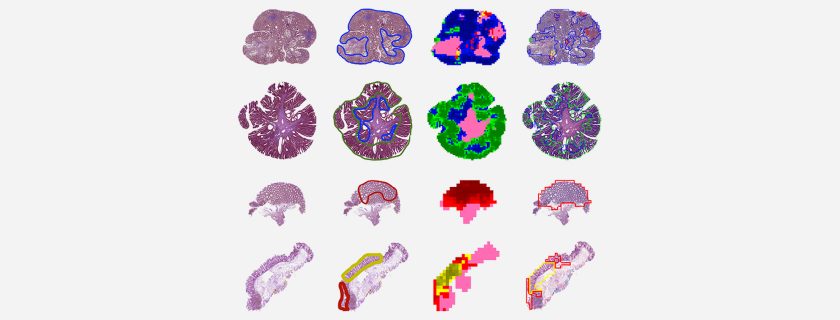
New AI Model Accurately Classifies Colorectal Polyps Using Slides From 24 Institutions
Dartmouth researchers have created an AI model to classify colorectal polyps on histology slides. Evaluation using 238 slides from 24 institutions across 13 US states finds that the model performs as well as practicing pathologists.