While focusing on different populations as Robert Wood Johnson Foundation Clinical Scholars, Geisel alums Anita Arora and Carolyn Presley are both working toward the common goal of improving health care delivery.
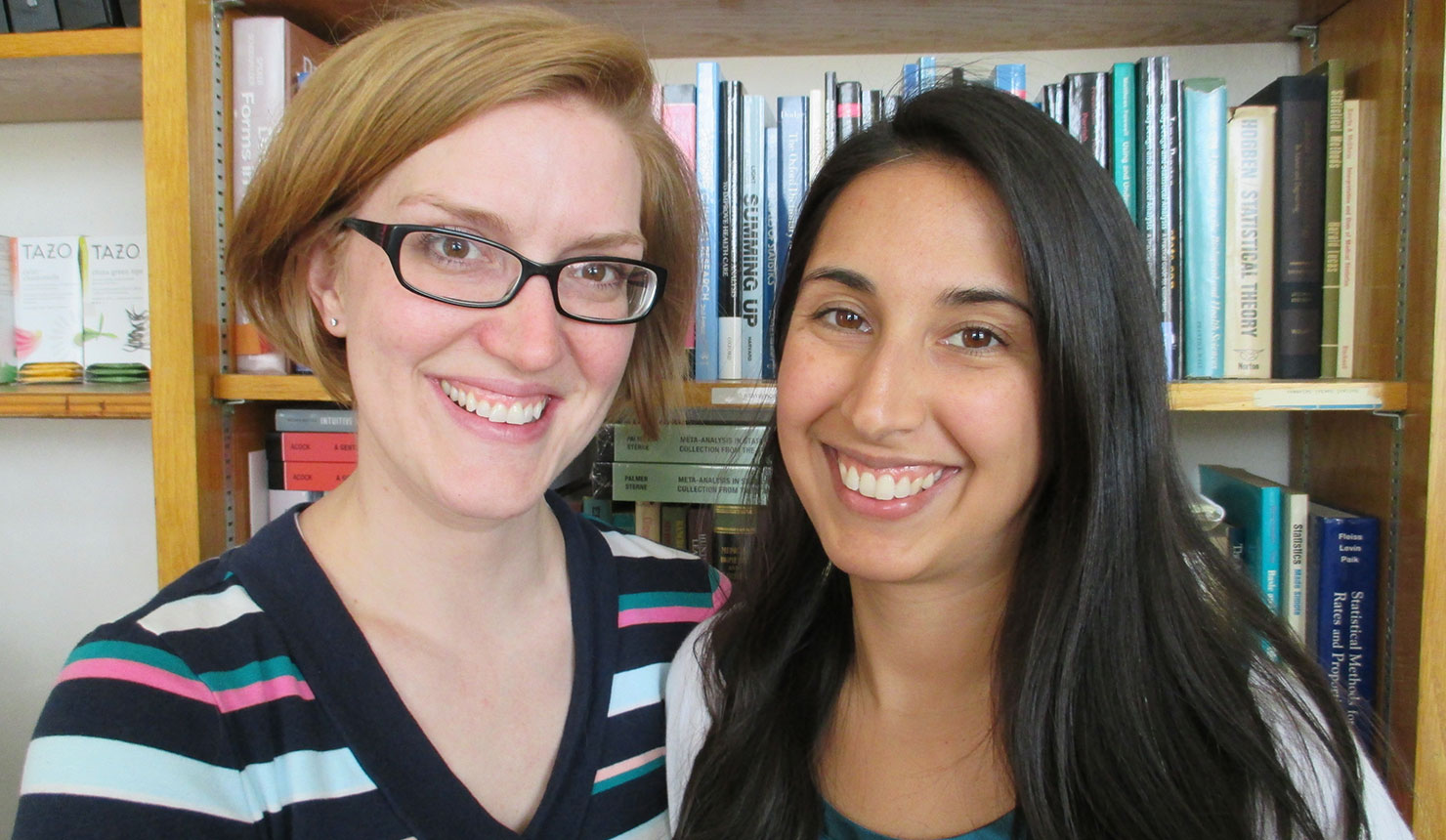
While focusing on different populations as Robert Wood Johnson Foundation Clinical Scholars, Geisel alums Anita Arora and Carolyn Presley are both working toward the common goal of improving health care delivery.
Watch story – Features a new study led by David Bzik, professor of microbiology and immunology, that has “identified which parasite proteins and which immunological pathways are required to break [this] immune tolerance.”
Listen here – As a guest on “Going for Gold,” Elizabeth Talbot, associate professor of medicine, discusses the many issues facing Rio as the Olympics arrive. (Talbot’s comments begin at approximately 15:00.)

A research team at The Dartmouth Institute for Health Policy and Clinical Practice has received a $2 million funding award from the Patient-Centered Outcomes Research Institute (PCORI) to conduct a research project that is likely to change the way women and their doctors make decisions about breast cancer surgery.
Read article – Cites a study led by Kris Bujarski, MD, Assistant Professor of Neurology, that assessed social cognition in 43 people with focal epilepsy and 22 healthy controls and found that people with epilepsy had no difficulty identifying positive emotions, but that they found it more difficult to pinpoint negative emotions such as anger, fear and disgust.
Read article – Quotes Elijah Stommel, professor of neurology, who is working with Applied GeoSolutions of Newmarket to study possible environmental links to ALS, also called amyotrophic lateral sclerosis or Lou Gehrig’s disease, by using satellite technology and onsite water testing.
Read article – Quotes A. James O’Malley, professor of the Dartmouth Institute for Health Policy and Clinical practice and of biomedical data science, about the recent release of the U.S. Centers for Medicare and Medicaid Services star ratings for 3,662 American hospitals.
Read article – Alison Volpe Holmes, an assistant professor of pediatrics, community and family medicine and of The Dartmouth Institute, is quoted in this article highlighting new approaches in treating infants experiencing neonatal abstinence syndrome, caused by opioid exposure during pregnancy. The article also highlights a three-year project by faculty, staff and students at CHaD and Geisel to develop better ways to care for infants with NAS.
Read article – Jay Buckey, professor of medicine and adjunct professor of engineering, is quoted about a recent paper that examined how deep space travel may have affected the cardiovascular health of Apollo astronauts. Buckey notes that unexplored risk factors could also explain why two Apollo astronauts died of cardiovascular disease. “Were they smokers? Did they have a family history of heart disease? Did they have high cholesterol? Those are all factors that could lead to heart disease, without having to bring galactic cosmic radiation into the mix,” says Buckey.
Watch story – WMUR-TV story examines the life and career of Nathan Smith, who founded Dartmouth’s Geisel School of Medicine in 1797. Smith was the school’s only professor for 10 years, and during his time at the College he treated the leg injury of six-year-old Joseph Smith, who later became the founder of the Mormon religion.
This page may link to PDF files. Use this link to download Adobe Reader if needed.