Read article – Bruce Stanton, a professor of microbiology and immunology, is featured in an article about efforts to teach children how to test wells for arsenic and other contamination. “A lot of kids get turned off by science,” Stanton said. “It’s kind of boring to read in a book. But if you actually do it, even if you don’t turn out to be a scientist, it gives you an appreciation of the scientific method.” (Picked up by CT Public.)
Articles by: Geisel Communications
Can Video Games Help Prevent Addiction? – The Boston Globe
Read article – Lynn E. Fiellin, a professor of biomedical data science, and Lisa Marsch, a professor of psychiatry and biomedical data science, are featured in an article about Fiellin’s company, Playbl, that offers five games about how to navigate opioids, tobacco use, sexual health, and mental health. The company was awarded $75,000 from the Dartmouth Innovation Accelerator for Digital Health. “We’ve seen that you can get really big clinical effects with these types of tools, not only in helping people with changing self-defeating patterns of drug use, but also lots of mental health applications, helping depression and anxiety disorders,” Marsch said.
New Self-Swab HPV Test Is an Alternative to Pap Smears. Here’s How It Works. – Live Science
Read article – Ilana Cass, a professor of obstetrics and gynecology, is quoted in an article about a self-swab HPV test for cervical cancer screening. “If we are able to invite more people in for testing through these expanded technologies, who would have previously been uncomfortable or would have been uninterested, this is really great. This is progress,” Cass said.
MD Class of ’28 White Coat Ceremony Livestream
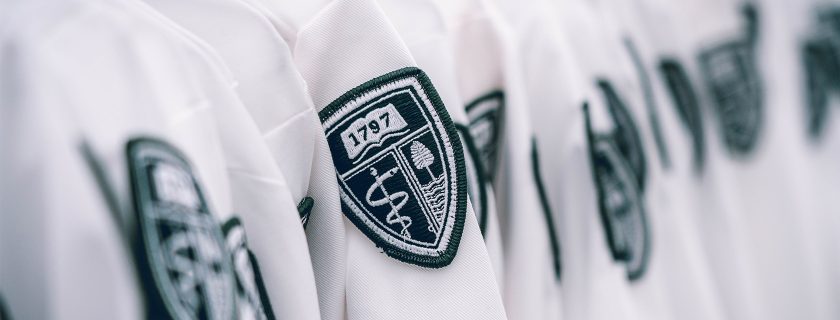
The White Coat Ceremony for the Geisel MD Class of 2028 will be held on Friday, September 27. The program begins at 3:00 pm. You can watch our live broadcast of the event here or on YouTube.
Five Steps to Improve Colonoscopy Performance – MedScape
Read article – Heiko Pohl, a professor of medicine and The Dartmouth Institute, is featured in an article about improving colonoscopy performance. “When we think about improving colonoscopy performance, the goal is to prevent colon cancer death, but when we expand that, we have to apply sustainable practices as a domain of quality,” Pohl said.
Q&A: When to Use Digital Breast Tomosynthesis for Cancer Screening – Healio
Read article – Features an interview with Anna N. A. Tosteson, a professor of the Dartmouth Institute, about her research comparing mammography and digital breast tomosynthesis for cancer screening. “We did this study because the limitations of mammography screening for women with mammographically dense breast tissue have been recognized,” Tosteson said.

Geisel Hosts First Annual White Coat & Gavel Games
Geisel hosted the first annual White Coat & Gavel Games with teams from Larner College of Medicine and Vermont Law and Graduate School on September 7.
Study Finds Prevalence of Firearms Is Driving Soaring Gun Deaths in U.S.—Not Mental Illness – Oregon Capital Chronicle
Read article – Charles R. Thomas, a professor of medicine, is mentioned in an article for contributing to a study into the rise of gun deaths in the U.S. The study found that the prevalence of firearms in the country is the primary reason for the increase in deaths, not mental illness.
Scientists Are Collecting Pee From SpaceX Travelers. There’s a Good Reason. – Mashable
Read article – Jay Buckey, a professor of medicine, and Mimi Lan, Thayer ’24, are featured in an article about being part of the team of researchers monitoring the health of astronauts on the Polaris Dawn mission. Their device collects the astronauts’ urine to track bone loss and to monitor whether a space traveler is at risk for developing kidney stones.
Dartmouth Launches Two New Programs in Advanced Medical Training – NBC 5
Read article – Dartmouth is mentioned in an article about Dartmouth Health’s new medical device development curriculum through its 3D Scholars program–a one-year certificate program tailored for active clinicians in medical device-focused specialties. The curriculum includes a boot camp and a capstone project hosted at Dartmouth.