
Amber J. Heck (Editor), Amanda J. Chase PhD (Editor), Jeff Fritz PhD (Editor), Nicole J. Borges PhD (Editor)
Addressing a gap in the medical education literature, Medical Science Educator Handbookprovides a comprehensive, focused resource in every key area of professional identity formation. It covers the entire spectrum of medical science educator development, dividing content into three practical sections: personal development, curriculum development, and professional development ―the key components that help you develop strategies to navigate the academic waters and flourish as a medical science educator.

Vibell J & Thesen T. Brain Imaging Essentials: Current Tools and Their Capabilities. Cambridge University Press; 2026.
Brain imaging is the foundation of cognitive neuroscience research and increasingly important for many domains in the behavioral sciences. This book provides a complete introduction to brain imaging for students, using non-technical and accessible language. Each chapter presents a specific brain imaging modality within its scientific context, addressing practical implementation, experimental design considerations, and analytical approaches. All the most commonly used techniques are covered, including fMRI, EEG, MEG, PET, TMS, FNIRS, and ECoG. By examining the latest tools in the field today, readers will develop critical skills for selecting appropriate techniques to address specific research questions in their own work. The authors draw upon their substantial experience as both researchers and educators in brain imaging and neuroscience to turn technical complexities into approachable concepts. This book provides an essential foundation for newcomers to brain imaging while offering valuable methodological insights for more advanced students.
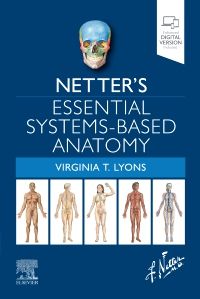
Lyons VT (2021) Netter’s Essential Systems-Based Anatomy. 406 pages. Elsevier Inc.
Designed for clinically focused, introductory anatomy coverage, Netter’s Essential Systems-Based Anatomy provides superbly illustrated core content in anatomy in a concise, easy-to-understand format. This highly visual text contains student-friendly features such as basic information and vocabulary, key systems-based concepts, and interactive practice questions for review—all highlighted by outstanding illustrations by Frank H. Netter, MD, Carlos Machado, MD and other medical artists.
Peterson KH; Charlotte C; Ciesielski S; & Eidtson W. Realizing academic success within the health science learning environment. In L. M. Meeks & L. Neal-Boylan (Eds.), Disability as diversity: A guidebook for inclusion in medicine, nursing, and the health professions, 2020 (pp. 103-142).
Critically needed information that builds on prior work addressing gaps.
Includes lots of examples, templates and exemplars from all health sciences, especially in nursing Includes program development guidance
Konopasky A, Bunin JL, Varpio L. The Philosophy of Agency: Agency as a Protective Mechanism Against Clinical Trainees’ Moral Injury. In Applied Philosophy for Health Professions Education 2022 (pp. 157-171). Springer, Singapore.
Artino AR, Simons RJ, Konopasky A. Self-regulated learning. In An Introduction to Medical Teaching 2022 (pp. 25-43). Springer, Cham.
Lee, M.W., Witchel, H.J. (2022). Introduction: Intentional Innovation in Educational Technology and Media to Promote Students’ Holistic Development.
In: Witchel, H.J., Lee,M.W. (eds) Technologies in Biomedical and Life Sciences Education. Methods in Physiology. Springer, Cham. https://doi.org/10.1007/978-3-030-95633-2_1
Lee, M.W., Butler, A.C. (2022). The Flipped Classroom: A Guide to Making Evidence-Based Decisions About Implementation.
In: Witchel, H.J., Lee, M.W. (eds) Technologies in Biomedical and Life Sciences Education. Methods in Physiology. Springer, Cham. https://doi.org/10.1007/978-3-030-95633-2_6
Corliss, S.B., Lee, M.W. (2022). Assessment and Teaching of Professional Attitudes and Behaviors. In: Huggett, K.N., Quesnelle, K.M., Jeffries, W.B. (eds) An Introduction to Medical Teaching. Innovation and Change in Professional Education, vol 20. Springer, Cham. https://doi.org/10.1007/978-3-030-85524-6_15
Konopasky A, Artino Jr AR, Hua C, Battista A. Functional linguistics and health professions education: An exploration of individual and group reflection processes. In BA Diaz, RW Schrauf (Eds.), Applying Linguistics in Health Research, Education, and Policy: Bench to Bedside and Back Again. Boston, MA: DeGruyter. 2022.
Konopasky A, Bunin JL, Varpio L. The philosophy of agency: Agency as a protective mechanism against clinical trainees’ moral injury. In M Brown, GM Finn and M Veen, Applied philosophy for health professions education: A journey towards mutual understanding. 2022.
Artino AR, Simons RJ, Konopasky A. Self-regulated learning. In KN Huggett, K Quesnelle, WB Jeffries (Eds.), An introduction to medical teaching: The foundations of curriculum design, delivery, and assessment (3rd ed.). Cham, Switzerland: Springer Nature Switzerland. 2022