Kathryn Zimlich, PhD
About Me
Kathryn earned her BS from the University of Dayton in 2018, and her PhD from Montana State University 2026 where she studied at the Center for Biofilm Engineering. For her graduate work, Kathryn used quantitative flow cell microscopy to investigate population dynamics of synthetic Pseudomonas sp. biofilms fabricated with 3D bioprinting. 3D bioprinting is an emerging technology addressing the need for small-scale control over biofilm structure and has been used to build synthetic biofilms with desirable functional characteristics. However, the selective environment of a hydrogel matrix is often different from where biofilms were naturally selected to grow. Kathryn found that the 3D printed hydrogel matrix homogenized growth rate differences between Pseudomonas strains, and that the growth and behavior of self-assembled Pseudomonas biofilms in fluctuating nutrient and mass transport environments was not predictive of synthetic biofilm growth and behavior.
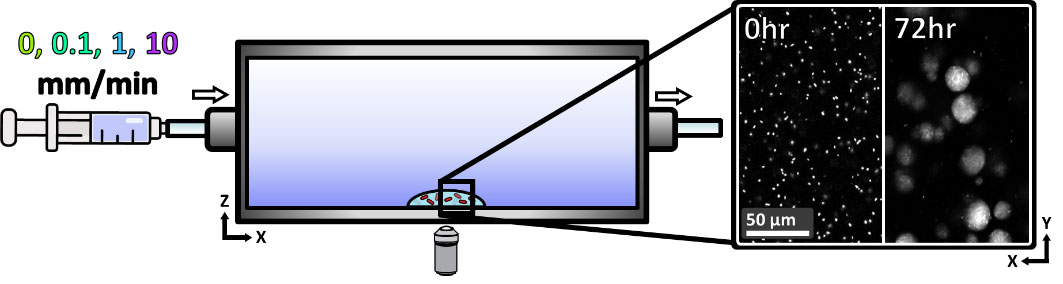 Diagram of Biosurface Technologies flow cell. Hydrogels are printed in the center of the flow chamber on top of the glass coverslip bounding the chamber. (Zimlich et. al. 2026, NPJ Biofilms, in review)
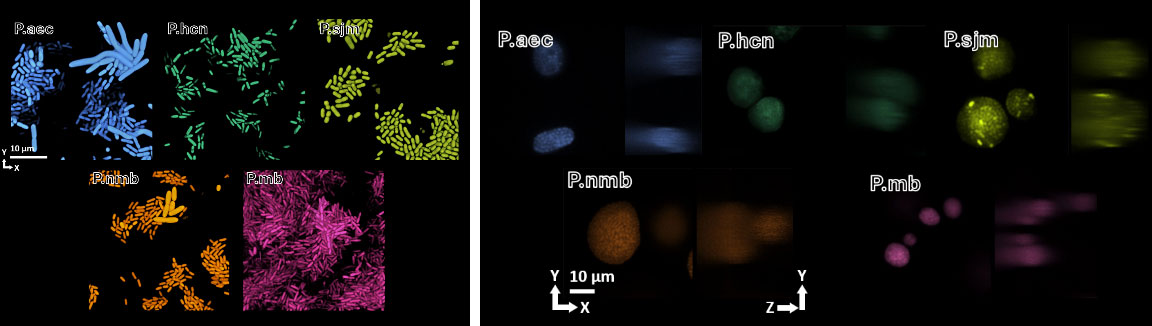 Self-assembled (left) and hydrogel-encapsulated (right) Pseudomonas sp. biofilms. (Zimlich et. al., 2026, J. Baceriol., in review)
Kathryn joined the Cramer lab in August 2026 as a postdoctoral researcher. She is deeply interested in the fundamental biology and evolution of biofilms and will be studying the spatial and temporal emergence of quiescence and dormancy in Aspergillus fumigatus. Using CRISPR/Cas9 genetic tools and quantitative microscopy, Kathryn will be exploring the biogeography of quiescence and dormancy in developing A. fumigatus biofilms, the connections between quiescence/dormancy and metabolic heterogeneity of A. fumigatus under various respiratory conditions and working on the development of continuous culture experimental systems.
Outside of the lab, Kathryn is usually climbing, playing with her cat, doing traditional archery, supporting tenant union organizing, or settling into a good video game.