Katherine Doss
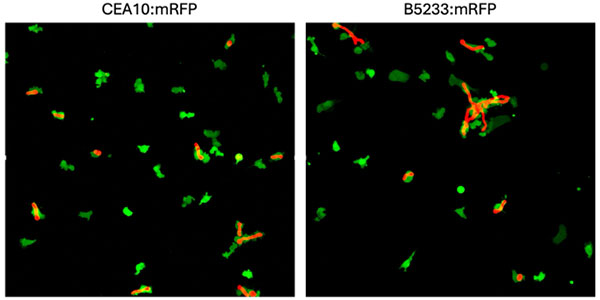 6hr germlings after a 3.5hr co-culture with neutrophils isolated from a healthy human donor at an 8:1 effector:target ratio. Fungus contains ectopically inserted mRFP (red) and neutrophils are stained with calcein AM (green).
About Me
Before joining Dartmouth’s MCB program in 2022, Katherine attended Stetson University in Deland, FL where she obtained a BS in Biology with a minor in Chemistry in 2021. While at Stetson, she studied under Dr. Jean Smith exploring the cell fusion protein Prm1. Specifically, she defined the functional conservation between Prm1 orthologs in Saccharomyces cerevisiae and Ashbya gossypii.
In the Cramer lab, Katherine is exploring strain-specific pathogenicity in the context of patients receiving small molecule therapies like ibrutinib. Unlike traditional models of immune suppression, only certain strains are pathogenic in a murine model of ibrutinib treatment. Surprisingly, the common laboratory strains CEA10 and AF293 do not cause disease in this model. Other strains, however, like another laboratory strain B5233 and clinical isolates from patients on ibrutinib, do. Using a combination of whole genome sequencing and directed genetic techniques, Katherine aims to elucidate the genetic mechanisms behind these differing pathogenicity phenotypes. Her work thus far has focused on the role of reactive oxygen species, from the fungal oxidative stress response to the host infection environment, as ibrutinib treatment appears to diminish the neutrophil oxidative burst. She has also developed an ex vivo coculture model to explore the interactions between human neutrophils, different A. fumigatus mutants and isolates, and ROS. Currently, Katherine is working to define the transcriptional response to oxidative stress and how that overlaps with in vivo fitness and strain-specific pathogenicity.
In addition to research, Katherine has a strong interest in teaching which she fosters by mentoring undergraduate students in the lab and participating in programming at the Dartmouth Center for the Advancement of Learning. When she’s not in the lab, you can find Katherine in the woods with her dog, Clove, or at home reading with her cat, Flynn.