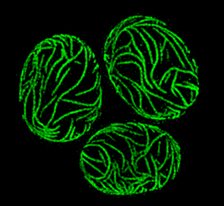
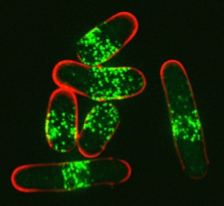
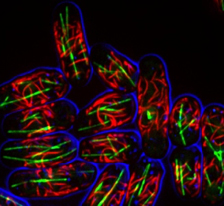
We study how cells coordinate cell growth and division. At the heart of this coordination are signaling pathways that link cell growth proteins with the core cell cycle machinery. We use a multi-disciplinary approach to identify these pathways, and then to understand how their activities are controlled by changes in cell size and shape. As many of these proteins are found at distinct sites in the plasma membrane, we have also become interested in the organizational principles that generate discrete compartments at the cell cortex. We use fission yeast cells as a model system because they allow us to combine a wide range of genetic, genomic, biochemical, and microscopy techniques. In addition, the basic cell growth and cell cycle systems are well conserved between fission yeast and human cells, where they have important links to the generation of cancer.
Ongoing projects in the lab include:
- How do cells stay the right size?
Many cells delay cell cycle transitions until they grow to a critical size threshold, but the mechanisms that measure size and transmit this information are largely unknown. Fission yeast cells grow to a reproducible size before entering into mitosis and dividing. We found that there are different signaling pathways that scale with cell volume, cell surface area, and time. These three pathways converge on the core cell cycle machinery that promotes cell division. We are studying these measurement systems and their related signaling pathways with the goal of generating a comprehensive understanding of the cell size control system. - Cellular adaptation to environmental stress.
Cells encounter and adapt to rapid changes in nutrients. When nutrients are limited, cells grow more slowly and divide at a smaller size. We are studying how nutrient sensing pathways signal to the core cell cycle machinery to signal division at a smaller size. In addition, we are investigating cell cycle control during meiosis, which is triggered by nutrient depletion. - Protein phosphorylation during cell division.
Protein phosphorylation is a post-translational modification that provides temporal and spatial control of many cell division proteins. We have discovered new roles for several conserved protein kinases and phosphatases during cell division, particularly during cytokinesis. We are interested in how specific phosphorylation events promote the assembly of the large macromolecular structures that power cell division including the mitotic spindle and the cytokinetic ring.