
Terry Fulmer, an adjunct professor of medicine at Geisel School of Medicine, nurse, and leading expert in geriatric care, has spent her career dedicated to improving the lives and healthcare of older adults. Acknowledging her leadership in advancing the healthcare of an aging population, she recently received the 2026 Gustav O. Lienhard Award for Advancement of Health Care from the National Academy of Medicine.
Her passion and commitment to provide evidence-based care has led to changes in the health and wellbeing of this population. While medical advances have extended lifespans, Fulmer says healthcare systems have focused on life-extending interventions without recognizing problems older adults face or planning for the care that will be needed for those extra years.
“Older adults did not ask to live this long, and sometimes they are victims of our technologic progress. Further, with longevity there is an increased possibility they will have changes in their memory. When that happens, they are at risk of being neglected or abused—about one in 10 Americans are now abused or neglected each year,” she says. “One reason for this increase is there are more older people, increasing caregiver demands. Another is we're making it very hard for our society to take care of them. The cost of nursing homes, homecare, and all long-term care services and supports, if you can get them, is staggering.”
Neglect worries Fulmer most—it can be so egregious it results in death. “You might live if somebody slaps you, but you will not live if they stop giving you food or water. We need to be vigilant in watching out for the wellbeing of older adults in our sphere—to make sure they receive the attention they need in the moment that they need it,” she says. “Elder mistreatment is often at the hand of somebody they know.”
The responsibility to ensure that older people get excellent care rests with all of us, and she believes “every day is an opportunity to think about what we can do to improve their care—following the science, making sure you're applying it regularly, and ensuring reliable care.”
Drawing on her early experiences and beliefs, Fulmer created the evidence-based NICHE program (Nurses Improving Care for Healthsystems Elders) based in the NYU Rory Meyers College of Nursing. Adopted both nationally and abroad, this care model is focused on protocols supporting nurses in all healthcare settings to lead substantive changes to improve clinical outcomes and better manage common health conditions and complications that affect older adults.
Responding to increasing demand for healthcare providers to care for an aging population, as President of The John A. Hartford Foundation Fulmer worked with Boston’s Institute for Healthcare Improvement and the American Hospital Association to launched Age-Friendly Health Systems. Based on her research of aging-related issues, her evidence-based 4Ms Framework standardizes care delivery and outcome aligned with the specific needs and preferences that matter to older adults, is the heart of Age-Friendly Health Systems.
“The 4Ms Framework—what Matters, Mentation, Medication, Mobility—has been adopted in more than 6,000 care locations across more than 12 countries and picked up by the Center for Medicare Medicaid as a required attestation measure that shows how they are addressing the age-friendly health protocols,” Fulmer says.
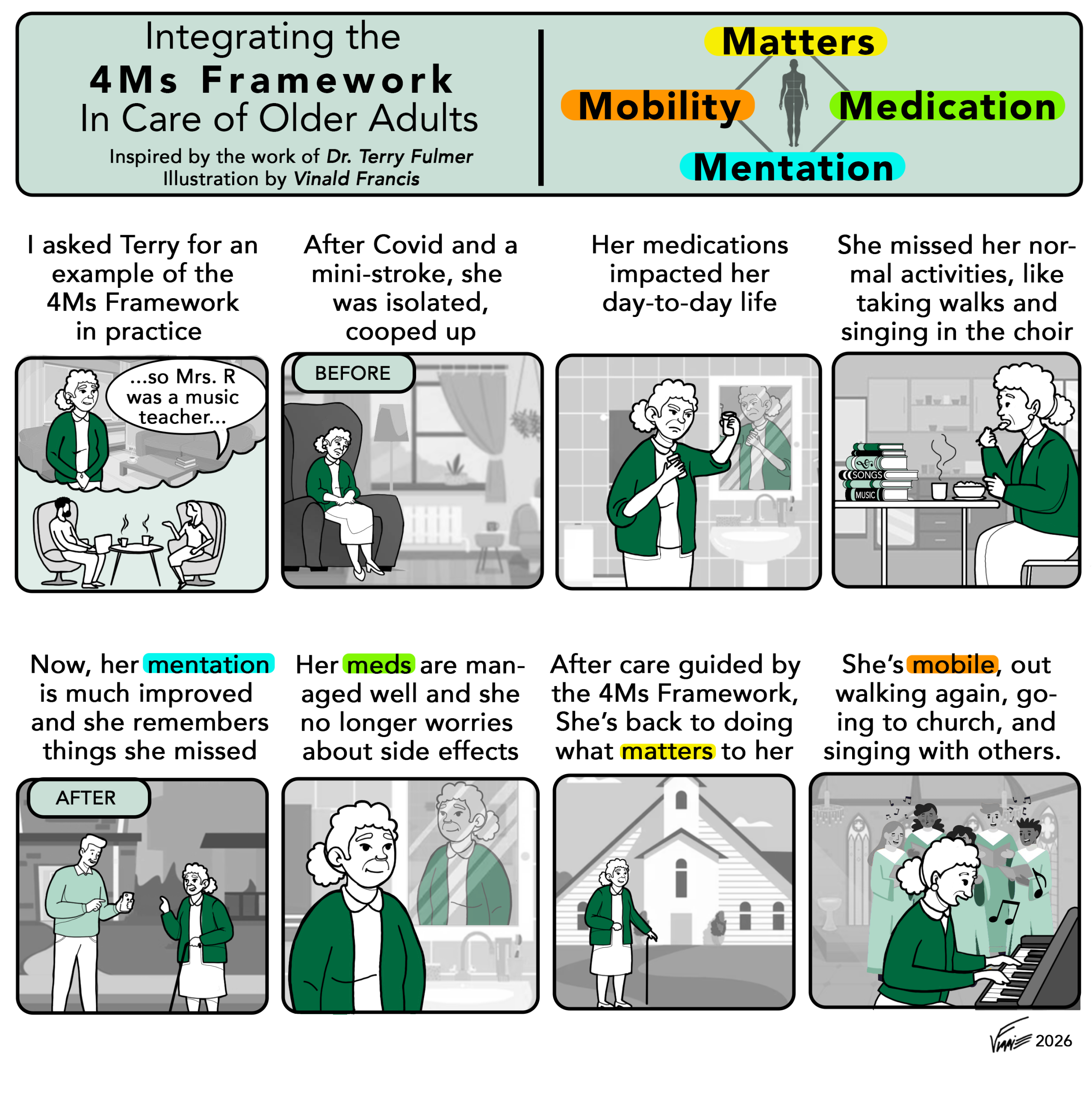 She has also co-authored geriatric nursing protocol books with Marie Boltz, an internationally recognized gerontological nurse scientist, to address he common geriatric syndromes identified through age-friendly care screening.
After stepping down from the Hartford Foundation, Fulmer brought her passion, research, and advocacy for improving elder care to Geisel, teaching interdisciplinary students and residents at Dartmouth Hitchcock Medical Center, as well as serving as an attending nurse.
Geisel is exactly where she wants to be.
“I intentionally reached out to Dartmouth because of the quality and the passion they have for geriatric care,” Fulmer explains. “My dear friend Ellen Flaherty, who is vice president of the Dartmouth Health Geriatric Center of Excellence,and Nate Goldstein, are people who I've admired for a long time.” Goldstein is the Herman O. West Professor of Geriatrics; Flaherty is an associate professor of medicine and of community and family medicine, and principal investigator of the Geriatric Workforce Enhancement Program.
Healthy aging in rural communities comes with unique challenges such as social isolation, limited access to services and transportation, affordable housing, food insecurity, and healthcare workforce shortages.
Fulmer and Flaherty have a long history of working together and are committed to resolving these issues and Fulmer says they are grateful to the Hartford Foundation for supporting this visionary work.
The duo worked together in rural upstate New York talking with healthcare providers to ensure age-friendly health systems and helping them implement the 4Ms Framework.
At Geisel, they are now traveling across New Hampshire and throughout New England to address the unique challenges those rural communities face by focusing on improving access to age-friendly care that is responsive to the needs of rural older adults.
“Being a part of the faculty, working with the medical students, residents, and practicing nurses to examine the way in which we can reliably provide age-friendly care, is a dream come true,” she says. “After being president of a foundation that funded this important work, I'm happy to get back to the grassroots—listening to challenging issues and helping with solutions.”