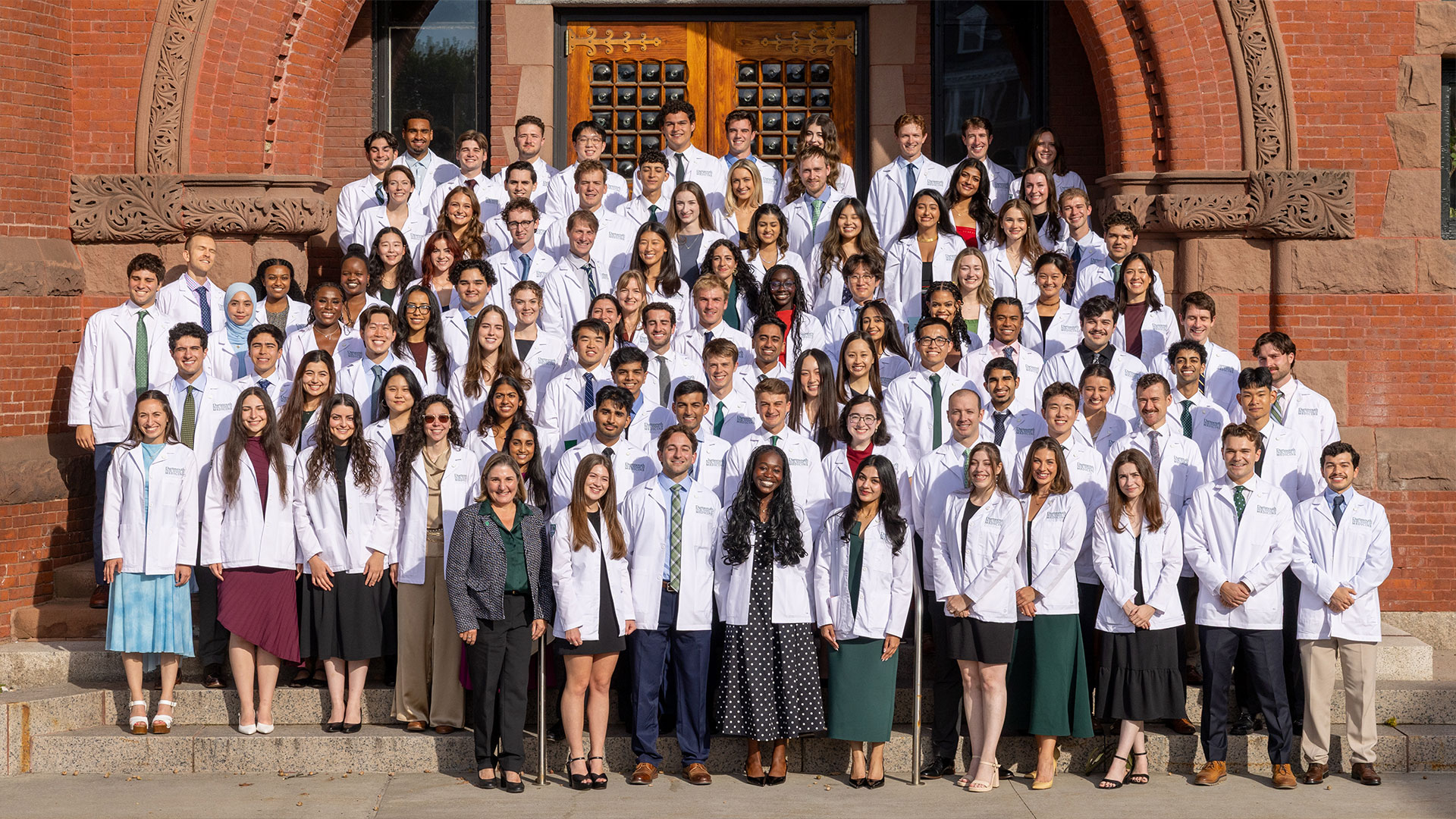
On Friday, September 25, during the medical school’s annual White Coat Ceremony, 96 first-year medical students in the Geisel School of Medicine MD Class of 2030 celebrated a rite of passage in the field of medicine when they received their short white coats, symbolic of their status as physicians in training. The ceremony is the first time students don the white coat, an iconic symbol in medicine representing the bond of trust between those who wear it and their patients.
Rather than receiving their white coats during orientation, as is common among many medical schools, Geisel medical students spend the first two months of their training in a clinical clerkship seeing simulated patients where they gain hands-on experience. This early immersion introduces them to the art and science of medicine, core concepts of humanism and professionalism, and commitment to patient care that they will carry with them throughout their medical training.
Welcoming remarks from several guest speakers, including Dean Jennifer Hunt, converged on Geisel’s ethos: the white coat is earned through accumulated experience and represents a promise of trust between physician and patient, not simply a symbol of scientific authority.
Recalling her early years in medicine, Hunt talked about what happens while wearing the “iconic uniform of the healer,” saying over the next several years, the medical students will gather countless experiences, planned and unplanned, that taken together will shape them into physicians—each is crucial, so none should be skipped or undervalued. Sharing an early lesson learned, she also encouraged them to own mistakes early and jump into action to correct them.
“… At the end of four years, your white coat will be dirty, worn, and a little shabby,” she said. “And it’ll hold the rich and rewarding experiences that mold and form you into the spectacular physician that you’ll be.”
Why does this piece of white clothing matter?
Historically, doctors wore serious black coats that were also practical for hiding stains. The shift to white in the late 19th century paralleled medicine becoming more scientific, lab-based, and focused on antisepsis, noted Roshini Pinto-Powell, associate dean of admissions, director of On Doctoring, and a professor of medicine and medical education.
Today, the coat symbolizes more than scientific knowledge; technical mastery isn’t enough if, as a physician, you fail to see the patient as a person, not just a diagnosis, she added. Though it’s just clothing, putting it on feels meaningful.
“The moment I put one on, it meant something deeply personal to me, and I have worn one throughout my clinical career,” Pinto-Powell said. “Today is the first time you will put one on.”
The coat carries authority and assumes trust before patients know anything else about you, but that trust must be earned; it is not automatic, she added.
“I believe the most important part of the White Coat Ceremony is that each of you gets to decide what your white coat will symbolize.”
White Coat Ceremony Photo Gallery (Photos by Rob Strong)
In a warm, humorous, and personal address, blending mentorship anecdotes with practical and philosophical advice for new medical students, keynote speaker Alexander Fuld, an assistant professor of medicine and of medical education, reflected on his 25 years as a hematology/oncology physician framed around the white coat.
Offering a humorous anecdote about how, as a medical student, he stuffed his coat pockets with so much stuff, including snacks, he added a custom-made pocket so he could carry more. By then the coat weighed more than 10 pounds. As a physician, Fuld confessed, he no longer owns a white coat.
He advised students to find their north star. “A point of reference. Something that is immutable that serves as an anchor, a guide, a focal point that doesn’t change even if you might. For me,” he said, “it is the patient and the commitment to helping them.”
Recognizing the individuality and the humanity of each patient is crucial, he emphasized truly listening to them because there is value in knowing something personal about each one.
He encouraged navigating uncertainty and embracing mistakes. “Medicine involves practical wisdom applied in messy, uncertain, real-world conditions. … Resilience comes from moving past losses, not avoiding them,” Fuld said, citing a Roger Federer anecdote.
Tying together the threads of his address, Fuld said—find your north star, don’t dwell on stumbles, remember Federer’s mindset, and keep snacks in your pocket.
Second-year medical student Kevin Cayabyab MED’29 shared a personal memory of growing up in rural California, where his family, immigrants from the Philippines, was taken in by an older couple, Jim and Jean Richardson. Though strangers with no obligation to help, instilled their own life lessons of hard work, and how to live with honesty, kindness, and service to others.
Cayabyab connected this story to the students’ new role as physicians, saying they are about to become the “Jim and Jean”in strangers’ lives, showing up for people who have no claim on them except need.
“They taught me how to live a meaningful life. To serve others. To build trust and community. To be honest and kind,” he said. “Their wealth and their life was not measured in dollars, status, or prestige. It was measured in something much deeper. I suspect a good number of you have someone like this in your own life.”
Cayabyab then framed difficulty and failure not as obstacles to becoming a good physician, but as the actual process of becoming one. Closing with a Robert Frost quote about having “promises to keep, and miles to go,” he urged the class to resist shortcuts and build the character needed to bear the weight of a medical career, and to someday become for someone else what Jim and Jean were for him.

In their White Coat Ceremony debut, the Geisel Grooves, a student-led ensemble performed selections from Elgar’s Chanson de Matin, Lehar’s The Merry Widow, Tchaikovsky’s Waltz of the Flowers from The Nutcracker, Bizet’s Carmen Intermezzo, Elgar’s Salut D'Amour. The processional was Handel’s Music for the Royal Fireworks and Strauss’s Radetzky March closed the ceremony.
All second-year medical students who share a love of music and performing, they have appeared at a variety of events across the Dartmouth Health, Geisel, and Upper Valley communities. Ensemble members include Arpie Bakhshian, violin; Irene Chang, bassoon; Maggie Cheng, sheng; Aren Choi, flute; Alex Daskalopoulos, viola; Demetri Garbis, double bass; Raymond Huang, piano; Mathew Lin, cello; and Michelle Yoon, clarinet.
If you missed the livestream of the White Coat Ceremony, you may watch a video of the celebration below.